
Search

The Fisherman - the Sixteenth (16th) Essential Santon for a Provençal Creche

Posted on June 22, 2014 by Sally Holman | 0 Comments

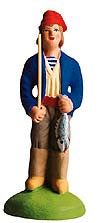
The Fisherman is number 16 on the list of the top 20 Essential Santons for a Provençal Creche. He is a pivotal figure in Provence, whether he works with his nets in the sea, or, as an angler, casting his pole into a local stream. As a Santon, his origin is in the early nativity plays and creche-parlant. Foremost, he is a classic figure of the Port of Marseille and its very important fishing trade of the Mediterranean. Fish, whether freshwater or from the sea, are basic to the Provençal diet. The Carbonel Santons workshop has created variations of each.

The Fishermen of the sea are represented by the Fisherman with a net - Pécheur au filet (French) - Lou Pescadou (Provençaux), available in all 4 sizes.

and the Octopus Fisherman - Pécheur au poulpe, in Size #3


They wear a seaman's jersey, have the trousers rolled up to their knees, wear red cotton caps on their heads, and are barefoot.

The Fishermen of freshwater are represented by the Angler – Pêcheur à la ligne (French) - Lou Pescaire (Provençaux), available in all 4 sizes.


and the Seated Fisherman – Pêcheur Assis, in Sizes #2 and #1


These two seated anglers are perfect to place by the side of a stream, or next to the bridge.

Of course, one cannot think of the Fisherman without thinking of the Fishwife - number 14 of the top 20 essential Santons.

Frederic Mistral, a Provençal poet, a winner of the Nobel Prize in Literature (1904), and a champion of the Occitan language (of which Provençaux is a dialect) of southern France, famously celebrated the Provencal fisherman in his epic poem of 1867, Calendal. In creating Calendal (the word "Calendula" is the Provençaux equivalent of "Noel" and was commonly given to each child born on Christmas Day), an anchovy fisherman from Cassis, Mistral invented "the Christmas fisherman." Calendal conquers monumental tasks, including inventing "ingenious fishing devices to bring all the fish of the sea into the port..." to win over his sweetheart, half-princess/half-fairy, Esterelle, a descendant of the Lord of Baux. The poem, a tribute to Provence, put Cassis on the map and sealed the importance of the Santon Fisherman. Calendal is commemorated in a statue by the harbor made of limestone from Cassis. As Mistral is often quoted: "He who has seen Paris and not Cassis has seen nothing."

Provençal legend tells us that before making his way to the manger, the fisherman first had to catch a fish to take as his gift. He "spent the night on the river, casting in vain. The water was cold and his hands were freezing,... A friend along the riverbank shouted the news of the Christ Child's birth. When a great trout overheard...." (Foley, p. 115) he took the bait deliberately, not to be left behind those wanting to see Jesus. Thus, the fisherman was able to successfully present the gift of his trade to the Christ Child.


Posted in Carbonel Santons, Provence Christmas

New for 2014 - Carbonel Santons Octopus Fisherman - Pécheur au poulpe - Size #2

Posted on November 04, 2014 by Sally Holman | 0 Comments

Every year the Marcel Carbonel Santons workshop in Marseille creates new Santons. 2014 brings a charming Octopus Fisherman - Pécheur au poulpe - Size #2 - the Elite size. 

The Octopus Fisherman is one of many Carbonel Fishermen. They make many anglers and fishermen with nets, but craft the Octopus Fisherman only in two sizes: the new one, in Size #2, and the other in Size #3, the Grande Size, seen here in this photograph of the finished Santon next to one newly molded, but yet to be fired or painted.

The Fisherman is number 16 on the list of the top 20 Essential Santons for a Provençal Creche. He is a pivotal figure in Provence, whether he works with his nets in the sea, or, as an angler, casting his pole into a local stream. As a Santon, his origin is in the early nativity plays and creche-parlant. Foremost, he is a classic figure of the Port of Marseille and its very important fishing trade of the Mediterranean. 

An integral part of Marseille's heritage, the Fish Market (Marché aux Poissons) is held on the quai des Belges on the Old Port. It is small, but ever so lively (the outspoken Fishwife being apocraphyl) 

 - buy the catch of the day fresh off the boat and have it weighed and cleaned for you while you wait. This is where the locals buy their fish for the day's bouillabaisse.  


Bouillabaisse (click here for a traditional Marseille Bouillabaisse recipe) is all about that catch of the day. The word bouillabaisse comes from "the Provençal Occitan word bolhabaissa, a compound that consists of the two verbs bolhir (to boil) and abaissar (to reduce heat, i.e., simmer). Bouillabaisse originally was a stew made by Marseille fishermen using the bony rockfish which they were unable to sell to restaurants or markets. There are at least three kinds of fish in a traditional bouillabaisse: typically red rascasse (Scorpaena scrofa); sea robin (fr: grondin); and European conger (fr: congre). It can also include gilt-head bream (fr: dorade); turbot; monkfish (fr: lotte or baudroie); mullet; or European hake (fr: merlan). It usually also includes shellfish and other seafood such as sea urchins (fr: oursins), mussels (fr: moules); velvet crabs (fr: étrilles); spider crab (fr: araignées de mer) or octopus." - Wikipedia

Octopus may be last on the Bouillabaisse fish list, but it is certain that it is not the least - one would imagine that when it was available it was considered a must!


Posted in Carbonel Santons, Provence Christmas

Santons Prayer - Christmas Eve in Provence

Posted on December 21, 2012 by Sally Holman | 0 Comments

The Santons Prayer quoted in the 1940s has traditionally been recited by the children of Provence as they gather around the creche after Christmas Eve supper has been celebrated.  Some refer to it as the Christmas prayer of the Children of Provence.

"Little Jesus of the Crib:
Make us philosophical as the fisherman,
Carefree as the drummer,
Merry as the troubadour in exploring the world,
Eager for work as the bugler, patient as the spinner,
Kind as the ass, strong as the ox which keeps you warm.
Give us the sacred leisure of the hunter,
Give us also the desire of the shepherd for earthly things,
The pride in our work of the knife grinder and the weaver,
The song of the miller.
Grant us the knowledge of the Magi, the cheerfulness of the pigeon,
The impulsiveness of the cock, the discretion of the snail,
The meekness of the lamb.  Give us the goodness of bread,
The tenderness of the wild boar, the salt of the haddock,
The good humor of old wine, the ardor of the candle,
The purity of the star.
Make us equal, dear Jesus, to our ancestors who honored you with their Christmas cribs.

Let us continue this custom while they watch over us in a Heaven which must resemble our Cribs with the Good Mother, the Infant Jesus, the angels, and these santons who are so kind they never speak an ill word of any person.

Pray, Lord, for our ancestors who passed down the Crib, for our mothers who taught us its art, for our fathers, for our homes.

We pray at your feet, Good Jesus, who wished to be born among the lowly people of this earth.

Pray for our native land, for the peace of its firesides, and for the future of our people.

Lord, pray for Provence!  And upon the sea of this world, guard it as the land of your affections!"

- Foley, Little Saints of Christmas, pp. 36-37

From what Foley says, it would appear that this traditional prayer was commonly customized to include all the Santons figures in each individual family creche.

We also found this shorter version, simply cited as an Old French prayer from Provence:

"Little Jesus of the crib.  Give us the virtues of those that surround you.  Make us philosophical as the fisherman.  Carefree as the drummer.  Merry as exploring the world as the troubadour.  Eager for work as the bugler.  Kind as the ass.  Strong as the ox that keeps you warm."

Posted in Carbonel Santons, Provence Christmas

The Hunter - the Fifteenth (15th) Essential Santon for a Provençal Creche

Posted on February 01, 2014 by Sally Holman | 0 Comments

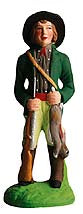
The Hunter- Le Chasseur (French) – Lou Cassaire (Provençaux) is number 15 on the list of the top 20 Essential Santons for a Provencal Creche. He is available in all four Marcel Carbonel Santons sizes.


He hunts the low, soft-leafed, scrublands of Provence - the "garrigues."  His outfit is classic:  a natty jacket, a broad-brimmed black hat and boots, his gun in one hand, a rabbit in the other, and his game-bag over his shoulder.

Like the infamous fisherman's yarn of the one who got away, the hunter spins his own tall tales and boasts of his exploits in his never-ending efforts to bag the perfect rabbit. It is a rabbit, or a hare, or perhaps a skewer of birds, that he brings as his gift to the Christ Child.

According to Daniel Foley, it was Santonnier Leon Simon (1845-1916) who introduced the hunter to the Santons creche.

For photos of the history and workshop of Carbonel enjoy our Marcel Carbonel Santons board on Pinterest.

Posted in Carbonel Santons, Provence Christmas

The Fishwife - the Fourteenth (14th) Essential Santon for a Provençal Creche

Posted on December 18, 2013 by Sally Holman | 0 Comments

The Fishwife - Poissonnière (French) - Le Peissouniero (Provençaux) is number 14 on the list of the top 20 Essential Santons for a Provençal Creche. She is available in all four of the Marcel Carbonel Santons sizes offered by My Growing Traditions. Colorfully dressed, she has a portable scale (copper steelyard) fastened to her belt and with a proud humility commonly brings a bountiful gift of not one, but two, basketfuls of fish to the manger.

As a fishwife, or fishlass, she is a woman who sells or works with fish. She is not necessarily a married woman, as the word "wife" here simply means woman. She is the female version of a fishmonger. Of course, she may indeed be the fishmonger's wife. She may be rough around the edges, but she is a hearty soul - one who has existed in Provencal life "forever" and thus, equally important to the Santons creche. She is celebrated in this 1995 French postage stamp.

We picture her as the wife or co-worker of the Fisherman with the Net, also available in all four of the Santons sizes that we have available.


In the pastorale of Jean-Francois Audibert, Pistachié is the husband of Honorine, a fishwife.

Posted in Carbonel Santons, Provence Christmas

The Story of Marcel Carbonel Santons

Posted on November 10, 2024 by Sally Holman | 0 Comments

We are delighted to share this wonderful article by Camille Renoux on the tradition of Marcel Carbonel Santons - the premier Santons workshop in Provence, which we are very proud to carry. Only Carbonel paints Santons with the meticulous painting processes detailed here.

"During December in Provence there are numerous fairs selling individual handcrafted traditional crib figures known as santons made in the region.

One of the oldest workshops is Santons Marcel Carbonel, named after the first man to be awarded Meilleur Ouvrier de France for his work as a santonnier in 1961 (santonsmarcelcarbonel.com).

The company, awarded Entreprise du Patrimoine Vivant for its traditional savoir-faire has stayed in the same family for four generations.

Why are santons made in Provence?

The first live crib was created by Saint Francis of Assisi during a mass in the forest of Abruzzi in Italy in the 13th century.

In the 17th century we know that a Capuchin friar, with a gift for sculpture, reproduced the characters for use by his congregation in Marseille.

Up until the Revolution, churches used to have nativity scenes at midnight mass, but afterwards these were forbidden and people started making miniature versions they could display in their own homes.

First, they would make them out of anything to hand, but gradually a profession grew up around them.

Master-craftsmen appeared in the 19th century and they would include characters from everyday life.

The first annual Foire aux Santons et aux Crèches was in 1803 in Marseille, and it is still an annual event today. Provence probably became the centre because the craftsmen made the figures out of clay which was readily available in the region.

Who was Marcel Carbonel?

He was a well-known santonnier who had studied at the Beaux Arts and worked as a lithographer before he started making his first crib figures in 1935.

His father, who was an electrician, also made cork santons as a sideline, which he sold at the Foire aux Santons in Marseille.

When he died, Marcel started making his own, out of clay. His figures stood out from others because he made his own natural pigments, still used today, to decorate them so they were brightly coloured but not shiny. He painted the faces with fine details which made the figures come alive as real personalities. He set up his first workshop in Marseille in 1942, and we are still here nearly 80 years later.

How are the santons made?

Everything is done by hand. First a character has to be designed and created.

Every year we introduce a new one to our range. Then a plaster mould is made and copies of a poorer quality are made which are sent out to our crafts people who mostly work in their own homes.

The poorer quality mould is designed so that it will not last for long, so it won’t be copied. It is in two parts. The clay is pressed into each side and then pressed together. The figure is released from the mould and carefully trimmed so that you cannot see any trace of the seam.

The craftsperson adds fine details such as the handle of a basket or the drumstick of a tambourine player by hand. After drying the figures are fired in a kiln. “Each piece is checked at each stage of the production and rejected if there is the slightest sign of any defect.

There are two firings a week all year round. Santons are in the kiln for 24 hours. It takes 12 hours for the kiln to heat up to its maximum temperature of 980°, they bake for six hours and then it takes six hours for the oven to cool so the figures can be taken out without cracking.

How are they decorated?

There is a chief decorator who works out the detail of each character and other decorators follow his or her instructions.

The watercolours are all prepared in our workshop. Each figure has 16 layers of paint. The decorators paint 50 at a time, and repeat the same layer on each one, so by the time they have reached the last one, the first has dried and they will be able to start with the next layer.

Each decorator paints around 150 a week. Each piece is checked at each stage of the production and rejected if there is the slightest sign of any defect.

What skills do you need to make santons?

You have to have passion and dedication. Santonniers have to be very meticulous with great attention to detail.

Who are the figures in a Provençal crib?

The different local crafts and jobs are represented as well as the biblical figures found in all crib scenes.

They come from the Pastorales Provençales, [plays which are traditionally acted out around Christmas, particularly around Marseille. They depict the nativity story as it would have happened if it had been in Provence].

Our characters come from one of the most-famous pastorales called la Maurel. All types of work carried out by local people are represented. There are olive pickers, stone masons, shepherds, lavender pickers, a woman with a baby, a monk, a fisherman and so on. Every year we add a new figure. This year’s was a hat maker.

When is the crib set up?

Traditionally, families open the box where the crib has been stored all year in November. They plan what it will look like and what new characters to add.

Maybe there will be a walk to collect moss, leaves and small wood chips to decorate the scene. It takes time to set it up. The finished crib is then traditionally on display from Sainte-Barbe, on December 4.

This marks the beginning of the Christmas season in Provence when wheat grains are planted in three saucers of humid cotton and if they have grown well by Christmas Day it is a sign of a good year ahead. Every day the santons are moved to create a new scene.

Finally, on Christmas Eve, the Baby Jesus is laid into the manger, at midnight. The three Kings start approaching until they arrive for the Epiphany. The crib is then put away until the next year.

Are your clients mainly from Provence?

We have customers all over France. It is a tradition that has spread throughout the country. Often families add a new figure every year and grow their collection.

They are all types of people. Provençal, Parisian, religious, carrying on a family tradition. Often the crib is passed down the generations and we have families who have been faithful to us over many years. We also sell to the United States, Japan, Belgium and Switzerland.

Many countries have their own cribs. What is different about those from Provence?

We have a museum with more than 2,000 pieces from the 18th, 19th and 20th centuries from all over the world.

They are made in many different materials including wood, cork, paper, glass and porcelain. In Provence, they are made from terracotta. There are five major producers including ourselves in the region and we all have our own characteristics."

Posted in Carbonel Santons, Christmas Traditions, French Christmas, Nativities, Provence Christmas