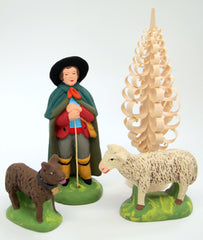
My Growing Traditions has created Marcel Carbonel Santons Shepherd gift sets in three sizes. Size #3 (Grande),
Size #2 (Elite),
and Size #1 (Cricket).
Each set includes the Young Shepherd, his herding dog, a standing sheep and a hand-carved tree (Spanbaum) from the Erzgebirge, Germany and is at a special price providing savings over purchasing the Santons separately. All are tucked neatly into a gift box from My Growing Traditions and include a My Growing Traditions Shepherd card.
Posted on
October 25, 2012
by
Sally Holman
| 0 Comments
In March 2012 we published Essential Santons for a Provencal Creche - a list of the top 20 Santons included in the creche by the Provençal people. The Shepherd - Le Berger (French) - Lou Pastre (Provençal) was the number one Santon included. It was to the Shepherd that the Angel came to announce the birth of Jesus. The Shepherd then played the pivotal role of summoning all the Provençal villagers to the manger. The importance of the Shepherd is, without a doubt, symbolized by the fact that we find so many different types in the Marcel Carbonel Santons' creche. There exist more different Santons' Shepherds than any other figure. Three of Carbonel's Shepherds: the Old Shepherd, the Young Shepherd, and the Man with a Sheep, are available in all four sizes. Both the Old and Young Shepherds wear long homespun cloaks and black hats. See them here in Size #2:
To find them in the the shop, click on the links that follow.
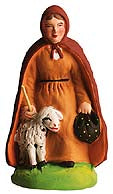
Two Carbonel Shepherds (more precisely, one is a Shepherdess) are available in two different sizes: The Kneeling Shepherd and the Shepherdess with a Cape. Both bring the baby Jesus a lamb. Find them pictured below in Size #2. Click here to see The Kneeling Shepherd in the shop: Size #2 and Size #3; and Size #2 and Size #3 the Shepherdess with Cape.
Carbonel's Size #3, offers two additional figures: The Shepherd from Arles and the Shepherdess with a Lamb. Both are special, although we admit to a particular affinity for the Shepherd from Arles.
The final Shepherd in the Carbonel Collection is the Sleeping Shepherd. He misses the Angel's call to the manger, as he is fast asleep. He is, indeed, a unique character. It feels best to wait and feature him in a separate, future blog post.
Posted on
November 24, 2014
by
Caitlin Holman
| 0 Comments
Every year the town of Istres in Provence celebrates the Shepherd with a two week festival traditionally held in the warmth of late fall/early winter. Founded in 1964, the Shepherd's Fair is a feast of Provençal tradition. Thousands of people attend to enjoy everything pastoral: homage to the transhumance (the seasonal migration of livestock, and the people who tend them, between lowlands and adjacent mountains),
sheep dog trials, music, crafts, food, and a wonderful parade and closing ceremony. All are clearly in love with Provençal tradition, and especially the costumes.We truly enjoyed this video of last year's festival - it is well worth the watch and takes one back to the Provence of the world of Santons.
Discovering the Festival and its celebration of the importance of the Shepherd in Provence, certainly made us pleased that we offer the Shepherd's Gift Set. The Shepherd Gift Sets are available in Sizes #1 (Cricket), #2 (Elite), and #3 (Grande) make a nice addition to your collection.
Save money with each set, which includes the Shepherd, the sheep dog, a sheep, and a hand-shaved tree (Spanbaum) from the Christmas village of Germany, Seiffen.
We included her in our very first entry on the 20 Essential Santons,the Shepherd being #1, at the very end of that post, as she is represented by the Carbonel workshops in four pieces, all tendering a lamb - two in Size #3
The Angel first announced the birth of the Saviour to the Shepherds. The Shepherds were the first to reach the manger, and summoned all the Provencal villagers to follow them. It is because Christ's birth was first revealed to the Shepherds (the Pastors) that the original nativity plays in Provence were calledpastorals. "Filled with wonder, the shepherds made their way to the manger carrying jugs of milk, wheels of cheese and a precious lamb. On the way, they stopped at every farm and village to tell of the wondrous happening....Their jubilance and excitement was infectious and it was not long before everyone who could walk was on his way with a gift or to offer assistance."(Foley, p. 83-84)
Posted on
November 03, 2015
by
Sally Holman
| 0 Comments
We have always found Marcel Carbonel's pack donkeys to be very special. They are one of our favorite figures and are definitely more than cherished by our customers.
Personally, our first experience with pack donkeys was in Morocco in the mid-1960s. Travelling in southern Morocco we would experience them in the mountains, traveling with their families, packed to the gills with all their possessions, young animals, and the youngest members of their families alike. We early learned to slow our pace to allow them to prevail on the road. Although not taken by us nor in Morocco, this photo always brings back those wonderful memories.
Memories that come to mind as we wrap up your pack donkeys ever so carefully - knowing how much joy they will bring you!
It turns out the donkey of Provence is special to us, and ever so special to Provence.
They came close to dying out. But, the people of Provence have made certain that would not happen.
They were especially bred for strength to help shepherds with sheep herding and the seasonal migrations - transhumance. The earliest records of Shepherds of Provence using pack donkeys dates to the fifteenth century, particularly during the seasonal migrations between the low ground where the sheep over-winter and the high alpine pastures where the sheep spend the summer months.
The donkeys of Provence were selected for their solid bone structure for carrying heavy loads, their docile temperament and good legs to carry them along the shepherds' migratory paths. The donkeys are outfitted with pack saddles that carry the equipment and supplies needed by the shepherds along the journey.
Modern transportation caused a sharp decline in the population of the Provence donkey (13,000 at the end of the 19th century, 2000 in 1956, and 330 in 1993. In December 1992 a breeder's association, the Association de l'Âne de Provence, was formed. They worked with the Haras National, in Languedoc-Roussillon to achieve recognition of the breed. In November 2002 the Provence donkey received the official recognition of the French ministry of agriculture.The current population is estimated at 1500.
One can understand why they are an integral part of Provence heritage and thus, are important figures in the Marcel Carbonel creche.
Enjoy our Marcel Carbonel Pinterest Board - Click here / and our Pinterest Board on Pack Donkeys - Click here
Posted on
October 29, 2012
by
Sally Holman
| 0 Comments
We were delighted to find a wonderful video from CNN on the work of Christian Werner. With his workshop in Seiffen, the Erzgebirge, Germany, Christian Werner is one of only eight master craftsmen in Reifendrehen - or ring-turning. His work is truly exquisite. Click on the image below for a lovely CNN video highlighting his workshop.
Posted on
December 09, 2018
by
Sally Holman
| 0 Comments
A Swiss nativity scene with a French touch - by Thomas Kern, pictures and text.
as published in swissinfo.ch - This is such a special celebration of a Santons Christmas, one cannot help but share the magic.
"Joseph, Mary, and the Christ Child are joined by common folk in a priceless nativity scene on show in northern Switzerland."
All alone, but not for long Putting the animals in position
"The nativity scene has been put together under the expert direction of art historian Rudolf Velhagen. Velhagen, head of the historical collection at the Museum Aargau, discovered the nativity figurines, 'Santons', while teaching art history in Marseille, and decided to bring them to Switzerland."
The people of Provence Creating the background by hand
"Made by the late French artist Marcel Carbonel, the Santons include not only the usual nativity figures, but common folk from a cross-section of Provençal society. There's a baker, knitting grandmother, fishmonger, vagabonds and men and women in traditional costume."
There's room for a shepherd....Putting together a nativity is much like putting together a train set.
"Velhagen has over 60 figurines in his collection. Each Santon has its place, representing society in its entirety and without any direct reference to the nativity story. An important source of inspiration for the figurines was the 'Lettres de mon moulin' by the French writer Alphonse Daudet (1840 - 1897), who describes happy and sad events."
They've arrived... Joseph and Mary The Three Kings are on their way
"The figurines are placed in reference to political or social conditions, while the traditional Santons - the shepherds, angels and the Three Kings - are moved each day, slowly approaching the birthplace of the Christ Child."
An angel has a prominent place.... As does a baker
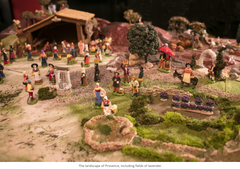
The landscape of Provence Missing Jesus... who arrives
Posted on
October 30, 2014
by
Sally Holman
| 0 Comments
Every year we build new Marcel Carbonel Santons (from Provence, France) Nativity Sets built around different stables. Saint Francis of Assisi is credited with creating the first nativity scene in 1223.
We always offer starter sets for Carbonel figures themselves (Mary, Joseph, and Jesus) and our Shepherd Gift set. Click here to see them in Size #2 (Elite) and here for Size #3 (Grande). All are a wonderful way to get started and to save some money.
Our one of a kind stable sets are available for Size #2. They include a stable, Santons figures, trees from the Erzgebirge, and Bavarian accessories. Enjoy the European tradition. Begin with a stable and the nativity figures. Over the years, add additional figures and Carbonel accessories, trees, and miniature accessories.
#1 - Charming Creche Set. This set includes Carbonel Ruin Stable with trees and eight figures: Mary, Joseph, Jesus, an Angel, three Kings, and a sheep. The accessories are from Bavaria and the Erzgebirge, Germany.
---------------
#2 -Wonderful Carbonel Nativity Set with German Accessories. This set includes a Courtyard Stable; Mary, Joseph, Jesus, three Kings, an Angel and a sheep. PLUS a sampling of accessories--all from Germany (the Erzgebirge and Bavaria).
---------------
#3 - An exquisite creche starter set. Combine French Santons figures with a German stable and accessories. This set includes: eight Santons: Mary, Joseph, Jesus, three Kings, Angel, and a sheep. A detailed hand-made stable reminiscent of the European Alps from Bavaria. PLUS German trees and accessories.
---------------
#4 - Nativity Set with Carbonel Santons and Stable with German Accessories. This set celebrates the arrival of a Shepherd with his sheep - the shepherd was the first to arrive at the manger. The stable is the Stable with Trees - Étable No. 2 bis avec arbres. Eight figures: Mary, Joseph, Jesus, the Man with a sheep, three sheep, and a lamb. The accessories are from Bavaria and the Erzgebirge, Germany..
---------------
#5 - A delightful creche set combining French Santons with a German Stable and accessories. A Bavarian stable - in the Alpine Tradition. Five (5) Santons figures: Mary, Joseph, Jesus, an Angel and a sheep. Accessories from Bavaria and the Erzgebirge, Germany.
---------------
and finally #6 - Nativity Set with Carbonel Santons and Stable with German Accessories. Santons Stable with trees and four Santons: Mary, Joseph, Jesus and a sheep. The accessories are from Bavaria and the Erzgebirge, Germany.
Click on the images above to find these nativity sets in our shop. We ship online via the United States Post Office. For the bulk of the items we offer, USPS is definitely the least expensive way to ship. Nativity sets and Stables are one of the exceptions, due to weight and package dimensions. It is possible that our nativity sets would ship less expensively via United Parcel Service. Place a telephone order - 1-877-832-6077 for a UPS delivery.
Posted on
April 25, 2013
by
Sally Holman
| 0 Comments
Roustido, The Man with the Lantern – Homme à la lanterne (French) – is the seventh most favorite Santon on the list of the top 20 Santons included in the creche by the Provençal people – see our earlier post, the Essential Santons for a Provençal Creche. He is available in all four Marcel Carbonel Santons sizes offered by My Growing Traditions.
Roustido derives from Antoine Maurel’s Pastorale. In the Pastorale, he is a friend and neighbor of Margarido and her husband Mr. Jourdan. Roustido is older and hard of hearing. A former notary, he is sometimes portrayed with a hat - see Size #1 - rather than his night cap (Sizes 3, 2, and Puce). As a notary he is also associated with a red umbrella, although the Carbonel studios have not used the umbrella with any of their Roustido Santons.
He is late to hear the shepherds call. One of the few remaining in the village in the middle of the night, he uses his lantern to go to Margarido and Mr. Jourdan in order to rouse them. Once at the stable he greets the Holy Family with a doff of his cap.
Posted on
December 09, 2015
by
Sally Holman
| 0 Comments
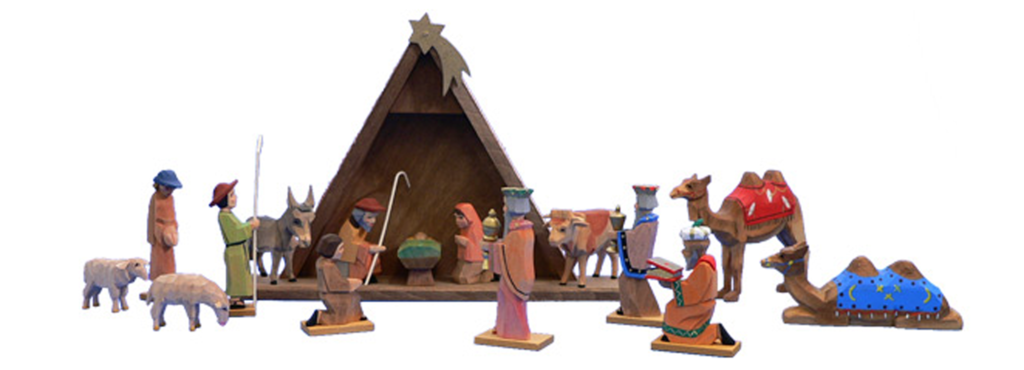
The nativity set from the Emil Helbig Workshop, the oldest wood-carving work shop in the Erzgebirge (Germany's Christmas Capital), is without a doubt one of, if not the, finest hand-carved German nativity sets.
The joy of the Emil Helbig Workshop nativity is all the possibilities - rejoice in the complete set (above).
We feel privileged to be able to offer the Emil Helbig nativity figures to you. To find them in our shop - click here or on any of the photographs above.
______________________
Emil Helbig Workshop - since 1933 Grunhainichen - A Toy Makers Village
Oldest Woodcarving Workshop in the Erzgebirge
Three generations strong - Celebrating the native Linden Tree Winner of the 2007 Erzgebirge Craftsman and Toy Makers Association Award for Outstanding Care in Preserving the Erzgebirge Tradition
Posted on
October 21, 2013
by
Sally Holman
| 0 Comments
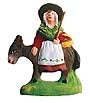
Margarido, The Woman on a Donkey – Femme sur l’ane (French) – is number 8 on the list of the top 20 Essential Santons for a Provençal Creche. She is available in all four Marcel Carbonel Santons sizes offered by My Growing Traditions.
Stemming from the early Christmas play, the Pastorale of Antoine Maurel, Margarido and her husband, Mr. Jourdan, are symbols of the middle class. She is infamous as a woman with a very bad temper, a gossip, and one who nags her husband. In the Pastorale, Roustido belatedly, as a latecomer, and in the middle of the night, beckons the couple to scurry to the Stable. There exist other references to Margarido arriving early at the Stable, literally travelling on the heels of the shepherds (the first to hear the angel's cry). Either way, Margarido comfortably and proudly rides her donkey, while trying to hurry along her husband as he trudges along beside them. Daniel Foley compares her to an "old duchess."
To shelter herself from the sun, she wears a wide-brimmed black hat over her white lace headdress and carries a basket filled with an offering, perhaps a gift from her garden or a cake, for the Christ Child.
Posted on
October 17, 2013
by
Sally Holman
| 0 Comments
This is the first year we have offered the Toy Shop Advent Calendar -
an old-fashioned toy store filled with teddy bears, cars, books, a baby buggy, dolls, rocking horses, the Three Kings with their camel, an elephant, and page, blocks, a Shepherd with his sheep, trees, a wonderful Bavarian Angel, a Christmas Pyramid, birds, etc., etc. It is simply charming. Glitter-dusted. 11" x 12" and Made in Germany. A delightful way to count-down to Christmas.
Supreme among Ulbricht's Christmas toys is a Santa, available both as an ornament and a toy alone - a roly poly toy to be wobbled like a weeble on a table top - the Wackelmensch.
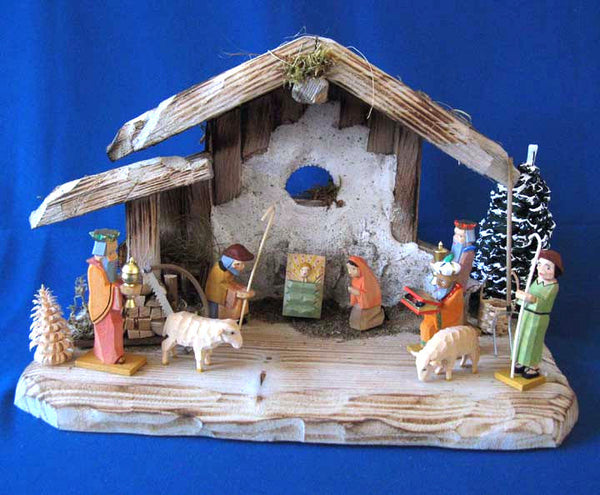
In addition to carrying their nativity set and figures and an increasing number of their other figures, we have enjoyed creating throughout the years Creche/Krippen/Crib sets with Helbig figures in a variety of Stables made in Bavaria and this year with a "Forest" platform from the Erzgebirge. Included in the larger sets are miniature accessories (pitchforks, pails, stacks of firewood, and the like) from Bavaria, plus trees from the Erzgebirge--everything handcrafted in Germany.
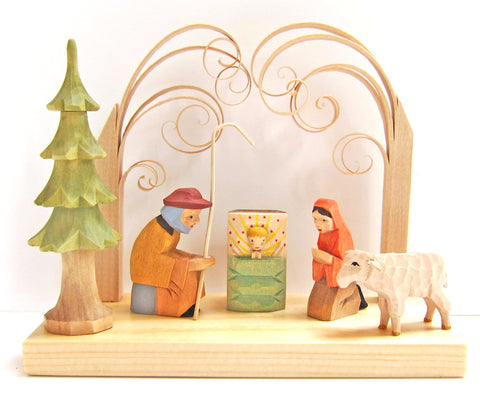
We thought we would share them here, beginning with the basic nativity figures on the Erzgebirge tree platform:
The set includes a solid hand-carved tree and a standing sheep.
"In the 18th and 19th centuries Provence experienced a boom in sericulture that would last until the First World War, with much of the silk produced being shipped north to Lyon. Viens and La Bastide-des-Jourdans are two of the communes of Luberon that profited the most from mulberry plantations that have since disappeared.[34] Working at home under the domestic system, silk spinning and silk treatment employed many people and increased the income of the working class." - Wikipedia
The Provence of the Santons world, of course, is one in which the Shepherd and his sheep and their wool is of utmost importance. Each Spinner holds a distaff of wool. The pinafore around her waist is folded up to form a pocket to hold the fleece with which she spins. She is available in all four sizes that My Growing Traditions offers.
Carbonel's older spinner works at a separate, wooden (depicted in clay of course) spinning wheel - Fileuse au rouet, available in Sizes #2 and #1.
Posted on
December 21, 2012
by
Sally Holman
| 0 Comments
The Santons Prayer quoted in the 1940s has traditionally been recited by the children of Provence as they gather around the creche after Christmas Eve supper has been celebrated. Some refer to it as the Christmas prayer of the Children of Provence.
"Little Jesus of the Crib: Make us philosophical as the fisherman, Carefree as the drummer, Merry as the troubadour in exploring the world, Eager for work as the bugler, patient as the spinner, Kind as the ass, strong as the ox which keeps you warm. Give us the sacred leisure of the hunter, Give us also the desire of the shepherd for earthly things, The pride in our work of the knife grinder and the weaver, The song of the miller. Grant us the knowledge of the Magi, the cheerfulness of the pigeon, The impulsiveness of the cock, the discretion of the snail, The meekness of the lamb. Give us the goodness of bread, The tenderness of the wild boar, the salt of the haddock, The good humor of old wine, the ardor of the candle, The purity of the star. Make us equal, dear Jesus, to our ancestors who honored you with their Christmas cribs.
Let us continue this custom while they watch over us in a Heaven which must resemble our Cribs with the Good Mother, the Infant Jesus, the angels, and these santons who are so kind they never speak an ill word of any person.
Pray, Lord, for our ancestors who passed down the Crib, for our mothers who taught us its art, for our fathers, for our homes.
We pray at your feet, Good Jesus, who wished to be born among the lowly people of this earth.
Pray for our native land, for the peace of its firesides, and for the future of our people.
Lord, pray for Provence! And upon the sea of this world, guard it as the land of your affections!"
- Foley, Little Saints of Christmas, pp. 36-37
From what Foley says, it would appear that this traditional prayer was commonly customized to include all the Santons figures in each individual family creche.
"Little Jesus of the crib. Give us the virtues of those that surround you. Make us philosophical as the fisherman. Carefree as the drummer. Merry as exploring the world as the troubadour. Eager for work as the bugler. Kind as the ass. Strong as the ox that keeps you warm."
Click on the image above to find them in our shop.
As one peruses the Santons literature, one discovers lists here and there of the specific Provençal characters vital to the creche. What makes the Santons creche so charming is that it is set not in Bethlehem, but rather in Provence. The nativity figures are in biblical dress. The additional creche figures typify characters found in an 18th or 19th century Provençal village, resulting in a year-in, year-out celebration of the area's history. The most authoritative list that we have found is from the book Provençal Figurines by C. Galtier and E. Cattin, translated by John Lee (Editions Ouest-France, 13 rue du Breil, Rennes, 1996). They make specific reference to "A Referendum for the Ideal Creche." Reportedly, L'Armana Prouvençau (a newspaper which we understand to be devoted to the preservation of the Provençal dialect and of all things Provençal) in 1968 published a list of 55 Santons (not including the basic nativity figures) from which they asked their readership to vote on which belonged in the "ideal creche."
L'Armana Prouvençau published the top 20 selected, with the number of votes received in the captions. The photos portray most of the figures in size #2. Almost all (or their equivalent) are available in all four sizes: Puce, #1, #2, and #3.
The Shepherd - le Berger (23,000 votes)
The Delighted One - le Ravi (21,414)
The Blind Man - l'Aveugle (16,734)
The Old Folk - Les Vieux (16,704)
The Knife Grinder - Le Remouler (16,476)
The Miller - le Meunier (16,170)
Roustido (14,820)
Margarido (14,070)
The Gypsy - le Bohémien (13,614)
Pistachie - le Pistaché (12,237)
Bartholomew - Bartoumiéu (10,476)
Jourdan - Jourdan (10,145)
The Tambourine-man - le Tambourinaire (10,122)
The Fishwife - la Poissonniêre (9,937)
The Hunter - le Chasseur (8,070)
The Angler - le Pêcheur à la ligne (6,042)
The Reeling-girl - la Fileuse (5,640)
Woman carrying Wood la Porteuse de fagots (5,148)
The Woman carrying Garlic - la Porteuse d'ail (4,188)
The Shepherdess - la Bergère (3,432)
A variety of other lists of the "basic Santons" vital to the creche scene include:
The Baker - le Boulanger
The Basketmaker - Vincent le vannier
The Dairymaid - Laitiêre
The Mayor - Monsieur le Maire
The Parish Priest - Monsieur le curé
The Washerwoman - Bugadière
The Woman with a Cradle - Femme au Berceau
The Woman with a Rabbit - Femme au lapin
An interesting observation is that in my research I discovered a number of sources that suggested that there were "55 essential figures to the basic Santons nativity." This statement exists in several renown French guide books. I have the feeling that the "55" figure is mistakenly derived from Galtier's book, where he quotes L'Armana Prouvençeau and the fact that in doing their survey they provided a list of 55 Santons from which they asked their readership to select the 20 most ideal. If you know otherwise, we would appreciate your comments. We would also be interested in hearing from you regarding which figures you feel are essential.
Posted on
November 10, 2024
by
Sally Holman
| 0 Comments
We are delighted to share this wonderful article byCamille Renoux on the tradition of Marcel Carbonel Santons - the premier Santons workshop in Provence, which we are very proud to carry. Only Carbonel paints Santons with the meticulous painting processes detailed here.
"During December in Provence there are numerous fairs selling individual handcrafted traditional crib figures known assantonsmade in the region.
One of the oldest workshops is Santons Marcel Carbonel, named after the first man to be awarded Meilleur Ouvrier de France for his work as a santonnier in 1961 (santonsmarcelcarbonel.com).
The company, awarded Entreprise du Patrimoine Vivant for its traditional savoir-faire has stayed in the same family for four generations.
Why aresantonsmade in Provence?
The first live crib was created by Saint Francis of Assisi during a mass in the forest of Abruzzi in Italy in the 13th century.
In the 17th century we know that a Capuchin friar, with a gift for sculpture, reproduced the characters for use by his congregation in Marseille.
Up until the Revolution, churches used to have nativity scenes at midnight mass, but afterwards these were forbidden and people started making miniature versions they could display in their own homes.
First, they would make them out of anything to hand, but gradually a profession grew up around them.
Master-craftsmen appeared in the 19th century and they would include characters from everyday life.
The first annual Foire aux Santons et aux Crèches was in 1803 in Marseille, and it is still an annual event today. Provence probably became the centre because the craftsmen made the figures out of clay which was readily available in the region.
Who was Marcel Carbonel?
He was a well-knownsantonnierwho had studied at the Beaux Arts and worked as a lithographer before he started making his first crib figures in 1935.
His father, who was an electrician, also made corksantonsas a sideline, which he sold at theFoire aux Santonsin Marseille.
When he died, Marcel started making his own, out of clay. His figures stood out from others because he made his own natural pigments, still used today, to decorate them so they were brightly coloured but not shiny. He painted the faces with fine details which made the figures come alive as real personalities. He set up his first workshop in Marseille in 1942, and we are still here nearly 80 years later.
How are thesantonsmade?
Everything is done by hand. First a character has to be designed and created.
Every year we introduce a new one to our range. Then a plaster mould is made and copies of a poorer quality are made which are sent out to our crafts people who mostly work in their own homes.
The poorer quality mould is designed so that it will not last for long, so it won’t be copied. It is in two parts. The clay is pressed into each side and then pressed together. The figure is released from the mould and carefully trimmed so that you cannot see any trace of the seam.
The craftsperson adds fine details such as the handle of a basket or the drumstick of a tambourine player by hand. After drying the figures are fired in a kiln. “Each piece is checked at each stage of the production and rejected if there is the slightest sign of any defect.
There are two firings a week all year round.Santonsare in the kiln for 24 hours. It takes 12 hours for the kiln to heat up to its maximum temperature of 980°, they bake for six hours and then it takes six hours for the oven to cool so the figures can be taken out without cracking.
How are they decorated?
There is a chief decorator who works out the detail of each character and other decorators follow his or her instructions.
The watercolours are all prepared in our workshop. Each figure has 16 layers of paint. The decorators paint 50 at a time, and repeat the same layer on each one, so by the time they have reached the last one, the first has dried and they will be able to start with the next layer.
Each decorator paints around 150 a week. Each piece is checked at each stage of the production and rejected if there is the slightest sign of any defect.
What skills do you need to makesantons?
You have to have passion and dedication.Santonniershave to be very meticulous with great attention to detail.
Who are the figures in a Provençal crib?
The different local crafts and jobs are represented as well as the biblical figures found in all crib scenes.
They come from the Pastorales Provençales, [plays which are traditionally acted out around Christmas, particularly around Marseille. They depict the nativity story as it would have happened if it had been in Provence].
Our characters come from one of the most-famous pastorales called laMaurel. All types of work carried out by local people are represented. There are olive pickers, stone masons, shepherds, lavender pickers, a woman with a baby, a monk, a fisherman and so on. Every year we add a new figure. This year’s was a hat maker.
When is the crib set up?
Traditionally, families open the box where the crib has been stored all year in November. They plan what it will look like and what new characters to add.
Maybe there will be a walk to collect moss, leaves and small wood chips to decorate the scene. It takes time to set it up. The finished crib is then traditionally on display fromSainte-Barbe, on December 4.
This marks the beginning of the Christmas season in Provence when wheat grains are planted in three saucers of humid cotton and if they have grown well by Christmas Day it is a sign of a good year ahead. Every day thesantonsare moved to create a new scene.
Finally, on Christmas Eve, the Baby Jesus is laid into the manger, at midnight. The three Kings start approaching until they arrive for the Epiphany. The crib is then put away until the next year.
Are your clients mainly from Provence?
We have customers all over France. It is a tradition that has spread throughout the country. Often families add a new figure every year and grow their collection.
They are all types of people. Provençal, Parisian, religious, carrying on a family tradition. Often the crib is passed down the generations and we have families who have been faithful to us over many years. We also sell to the United States, Japan, Belgium and Switzerland.
Many countries have their own cribs. What is different about those from Provence?
We have a museum with more than 2,000 pieces from the 18th, 19th and 20th centuries from all over the world.
They are made in many different materials including wood, cork, paper, glass and porcelain. In Provence, they are made from terracotta. There are five major producers including ourselves in the region and we all have our own characteristics."