
Emil Helbig Exhibit at the Seiffen Toy Museum - and yes, we carry their wonderful folk art
If, by any chance, you plan to travel to Germany before the 4th of May 2014, make a side-trip to Seiffen and their Toy Museum. From 16 November 2013 and 4 May 2014, the Toy Museum is holding a special exhibit of the work of the Emil Helbig Workshop in Grunhainichen. Founded 80 years ago, the Helbig Workshop is one of the oldest existing wood working workshops (Schnitzwerkstatten) in the Erzgebirge and considered one of its finest.

A graduate of the Dresden Arts and Crafts School in 1919, Helbig worked at the Meissen porcelain factory where he was discovered by Professor Alwin Seifert, the director of the "State Toy School." Helbig founded his own very special workshop in Grunhainichen in 1933. The exhibit at the Toy Museum includes many pieces that have never before been seen by the public.
We proudly carry their nativity, from the Mary, Joseph, and Jesus (shown here) to a full set of other nativity figures
 and many of their Christmas ornaments, this angel being only one of them. Visit here to see more delightful Helbig Christmas ornaments.

We look forward to carrying more and more Helbig folk art over the years. Let us know if there are specific pieces you are interested in.
Bartholomew – the Eleventh (11th) Essential Santon for a Provençal Creche
Bartholomew – Bartoumieu (Provençaux) is number 11 on the list of the top 20 Essential Santons for a Provençal Creche. He is available in all four Marcel Carbonel Santons sizes offered by My Growing Traditions.
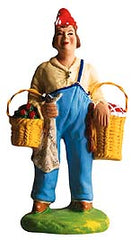
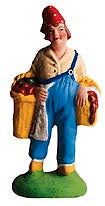


A character from the nativity plays (pastorales), Bartholomew, the village innkeeper (the word innkeeper is l'Oste in Provençaux), is proudly featured on Marcel Carbonel's brochures. He is one of the most loved and comical characters of the Provençal nativity and is, in fact, often the hero of these tales. He is a simple chap: friendly, cheerful, and an all around genial soul - looking at the world with a thoroughly positive nature. He has a tendency to get a little too tipsy from time to time and the miracle he receives upon reaching the nativity is to be cured of his drunkenness.
In his hurry, he has hastily dressed and his clothing is in a bit of disarray. He traditionally brings cod (essential to the Provençal dish l'aioli) and baskets of food to the Christ Child.
For photos of the history and workshop of Carbonel enjoy our Marcel Carbonel Santons board on Pinterest.
Nestled Contentment
New for 2013, Nestled Contentment (Inge-Glas no. 1-004-13, 3" tall) is a Limited Edition of 999 pieces, with Presentation Box. Each piece is hand-numbered.
 The coloration is not a perfect match, however, this little bird reminds us of an American Robin, especially the nest.
 We love Inge-Glas' bird ornaments - and they are renowned for them - but we do admit, that the two new ones this year (see also the Resting Waterfowl) each with an elegant bird sitting on its nest, and with the nests made of natural materials, are very special.
Nestled Contentment will, without a doubt, become a Collector's piece.
A Special Bavarian Cow in Celebration of the Almabtrieb
We truly enjoyed finding these special little cows - two German kuhe in Almabtrieb dress.


The one on the left wears a simple wreath of flowers around his neck, while the one on the right wears in addition, the traditional, elaborate headdress of the Almabtrieb.
The Almabtrieb celebration takes place at the end of summer when the cows are brought down from high pastures in the Alps to the valleys below. It is traditional for the Bavarians to celebrate this passage in traditional dress.
 These special hand-carved cows have been created by Hartmut Hennig of Deutschneudorf (just adjacent to Seiffen, the toy-making center of Germany) in the Erzgebirge mountains of Eastern Germany. They stand just an inch and half tall and are really quite exquisite.
You may also enjoy visiting our Bavarian board on Pinterest - where you will find images of so many things Bavarian, from food to costume to special places to visit.
Cooking Pot
New for 2013, Inge-Glas' Cooking Pot comes in four classic colors - blue, red, green, and flame -


all reminiscent of the cast iron pots from France made by Le Creuset that we are all so familiar with.
Click on the images above to find them in our shop.
A celebration of the cook in all of us and perfect for the Christmas tree. A remembrance of that delectable stew or soup filling our kitchens with an irresistible aroma.
You may enjoy exploring Le Creuset's manufacturing process and their iconic colors.
Pistachié – the Tenth (10th) Essential Santon for a Provençal Creche
Pistachié is number 10 on the list of the top 20 Essential Santons for a Provençal Creche. He is available in all four Marcel Carbonel Santons sizes offered by My Growing Traditions. He wears a cotton cap and has evidently dressed rather quickly as his trousers are held up by a single strap of his bracers. As the Carbonel Dictionary notes, he holds a lantern in one hand and a bucket in the other in Sizes #2, 1, and Puce, and a lantern and a broom in Size #3.




He is a figure drawn from numerous early Christmas plays, especially Antoine Maurel’s Pastorale, but others as well, and each portrays him with a slightly different personality. In the nativity he carries presents to the Christ Child. A farmhand, he is timid--even a little fearful--and not very bright, but he is jovial and a willing helping hand. In Maurel's Pastorale he adds comic relief to the play when it takes the entire village to rescue him after he falls into a well trying to fetch Margarido's donkey some water. And, he is renown for being a womanizer. His name, derives from the pistachio tree,

a common Provençal scrubland shrub. The pistachio is said to be an aphrodisiac.
In the pastorale Yvan Audouard of Jean-Francois Audibert, Pistachié is the husband of Honorine, a fishmonger.
Chef's Hat
The Chef's Hat, is one of Inge-Glas of Germany's new Christmas ornaments for 2013.

The chef's hat is a part of a traditional chef's uniform. Sir William Orpen's ca. 1929 painting of that traditional uniform

in Le Chef de l'Hotel Chatham, Paris is owned by the Royal Academy of Arts in London. It is an exquisite depiction of that classic Chef's uniform, including the hat, also known as a toque. The toque (French for "white hat") was especially popular throughout Europe, and particularly in France, from the 13th to the 16th centuries. It is worn to this day by professional chefs, for sanitary reasons to be certain, but also simply because of its tradition. It is said that the present day Chef's Hat was popularized by the famous French chefs Marie-Antoine Careme and Auguste Escoffier.
Inge-Glas' Chef's Hat is a fun addition to the Christmas tree for any gourmet, cook, foodie, or for anyone who simply enjoys a celebration of food.


